
Power vs. Influence
We live in a world obsessed with leadership, yet we continuously fail to understand what true leadership actually is. Every day, we watch people climb over each other to reach the peak of their respective hierarchies, clawing for control, status, and dominance. But if you want to understand the profound spiritual mechanics of leadership – and why so many modern institutions are fundamentally broken – you need to look no further than the dramatic sequence of events we read in the Torah over the last two weeks.
This week, millions of people around the world study Parshat Korach. It chronicles one of the most severe, bone-chilling challenges Moses ever faced as a leader. Korach, an influential Levite, allied himself with ambitious neighbors from the tribe of Reuben and 250 distinguished “princes” of the assembly. Together, they staged a massive, highly calculated mutiny against Moses and Aaron.
The rebellion didn’t end with a polite debate or a political compromise. It ended with the physical earth tearing itself open, swallowing Korach and his co-conspirators alive, while a Divine fire consumed the 250 princes.
It is a terrifying, absolute punishment. Yet, a glaring question demands an answer when we look just one week back in our reading.
In Parshat Beha’alotcha, two men named Eldad and Medad suddenly began “prophesying within the camp.” They were channeling the Divine spirit completely outside of Moses’s direct supervision. When Joshua ran to Moses in a panic, urging him to imprison them to protect his status, Moses famously brushed him off, responding: “Are you jealous for my sake? Would that all the Lord’s people were prophets!”
Why the radical disconnect? Why did Moses look at two rogue prophets with absolute joy and humility, but when Korach and his “band of merry brothers” approached with a similar grievance – claiming “the entire congregation is holy” – the response was a swift, catastrophic capital punishment?
The answer lies in an eternal, unshakeable truth of the cosmos: the fundamental difference between Power and Influence.
The Zero-Sum Game of Power
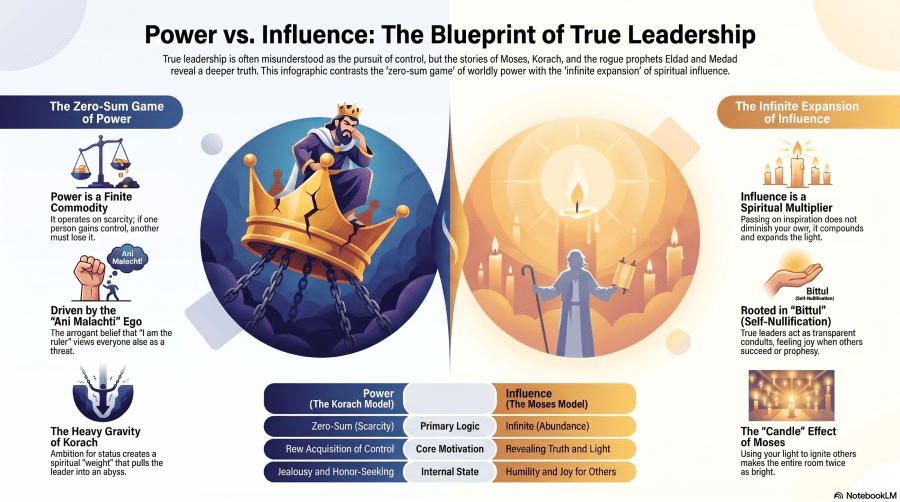
Power is a physical, worldly commodity. It is structural, hierarchical, and transactional. By its very definition, power is a zero-sum game. If I have an absolute kingdom and I decide to give you a piece of it, my portion automatically becomes smaller. If a manager shares their decision-making authority, their personal grip on control loosens. Because power operates on the plane of scarcity, those who operate strictly within the framework of power view everyone else as an existential threat.
Korach was entirely power-hungry. He didn’t want to elevate the people; he wanted to diminish Moses so he could occupy the vacuum. He coughed up beautifully crafted populistic slogans about equality, but his true motive was the raw acquisition of control. Because he viewed leadership through the narrow lens of a zero-sum game, his rebellion was a direct assault on the Divine order itself. He wanted a piece of the pie, and in the realm of holy authority, that species of localized ego must be utterly eradicated before it poisons the entire collective.
The Infinite Expansion of Influence
Influence, however, operates on an entirely different spiritual frequency. Influence is not about control; it is about inspiration, truth, and spiritual alignment.
When you are a person of genuine influence and you pass that inspiration onto someone else, your own influence does not shrink – it compounds. It expands. If I use my candle to light your candle, my light isn’t diminished in the slightest; rather, the entire room becomes twice as bright.
This is exactly what was happening with Eldad and Medad in the tents. They weren’t trying to steal Moses’s crown or strip him of his position. They were tapped into the same infinite Divine source, amplifying the light of truth and spreading it wider into the camp. They were helping Moses by absorbing the spirit and reflecting it to the people. Moses, operating in total alignment with the Almighty, recognized this immediately. Because Moses was the most humble man on earth, he had zero ego wrapped up in “power.” He only cared about holy influence, so he welcomed its expansion with an open heart.
The Breslov Perspective: The Tzaddik and the Fire of Ego
The holy teachings of Rebbe Nachman of Breslov take this dynamic to an even deeper psychological and spiritual level. Breslov Chassidut teaches us that the ultimate trap in this world is the illusion of “Ani Malachti” – the arrogant belief that “I am the ruler,” that my strength and my cunning are what sustain me.
Rebbe Nachman emphasizes that a true leader, a genuine Tzaddik like Moses, acts purely as a transparent conduit for the infinite light of the Creator. The Tzaddik has completely nullified his ego (Bittul). Therefore, when someone else speaks words of truth or experiences prophecy, the Tzaddik feels nothing but pure, unadulterated joy, because the ultimate goal – revealing God’s presence in the world – is being accomplished.
Korach, conversely, represents the tragic imprisonment of the ego. He looked at spiritual standing as a personal possession to be acquired, guarded, and envied. Rebbe Nachman warns that when a person is consumed by this toxic brand of jealousy and honor-seeking, their internal spiritual landscape turns into a burning fire.
It is entirely directionally obvious why the earth swallowed Korach’s assembly. When a person anchors their entire existence in the physical illusion of power and ego, they become entirely heavy, materialistic, and rigid. They pull themselves downward. The earth opening up wasn’t just a localized miracle; it was the physical manifestation of Korach’s own spiritual gravity pulling him into the abyss.
Slogans vs. The Blueprint of Truth
The Torah is not a book of historical folklore or ancient fables; the Torah is absolute Truth. It is a living, breathing blueprint that describes the exact human condition we experience today.
Look around our modern society. We are swimming in an ocean of smooth-talking people who use beautiful, egalitarian slogans to mask a deep, desperate hunger for raw power and state control. They tell us they want unity, but their actions create strict, unforgiving hierarchies where personal liberties are systematically traded away for the illusion of collective security.
We must learn the hard lesson of this week’s Parsha. We have to start looking past the sophisticated marketing and ask the confronting questions: Is this leader operating in the realm of zero-sum power, or infinite spiritual influence? Are they trying to light more candles, or are they trying to blow yours out so theirs looks brighter?
True, proper leadership will always recognize that all authority originates from the Divine. It doesn’t seek to accumulate; it seeks to inspire. Let us reject the heavy, power-hungry traps of Korach, break free from the matrix of ego, and strive to be like the prophets in the tents – spreading the ultimate light of truth further into the world without the bullshit.

