
We’ve all seen the glossy brochures for “Unity.” You know the ones – they use all the right buzzwords, plenty of soft lighting, and usually a soundtrack that tries a bit too hard to make you feel something. But if the Tower of Babel taught us anything, it’s that slogans are cheap. You can have everyone speaking the same language and still be building a monument to a massive, filtered-data-driven failure.
Real unity isn’t a marketing campaign. It’s what happens when the “different branches” of our people realize they are drawing life from the exact same root.
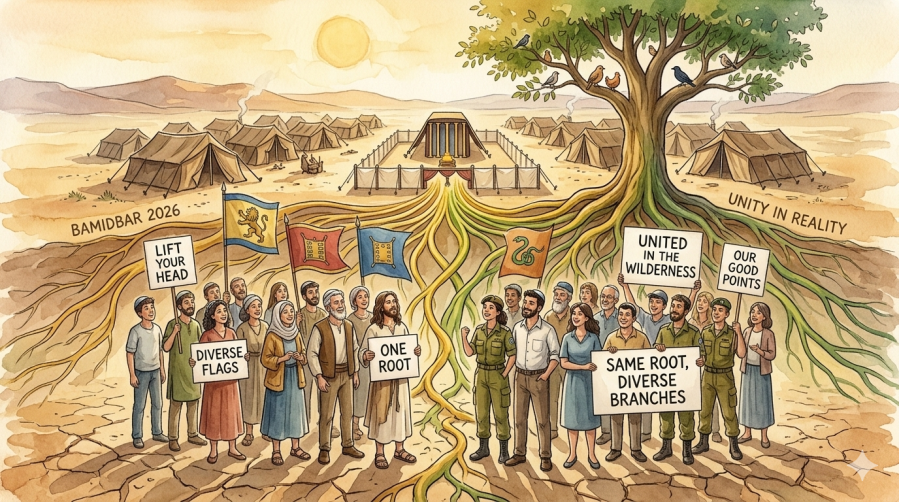
This week, we dive into Parsha Bamidbar. It’s literally “In the Wilderness”. You’ve got the Israelites wandering through the sand, and on paper, it looks like a logistical headache. But look closer at how they were organized. They had a census where they didn’t just count numbers; they “lifted the head” (se’u et rosh) of every man. It was about recognizing individual value in a crowd of over 600,000.
Then you have the Degel – the flags. Every tribe had its own banner. They weren’t asked to blend into a beige, characterless soup. They were told to stand under their specific flag, with their own identity and their own “Personal Mitzvah” or “good point” to contribute.
And here’s the kicker: they all circled the same center.
Fast forward a few thousand years. Not much has changed. We are still “In the Wilderness” in many ways, navigating a world that often feels as arid and unpredictable as the Sinai. But after October 7, the Jewish people moved from a theoretical, academic discussion about unity into a lived reality that mirrored that ancient camp in Bamidbar.
We saw authentic diversity in its rawest, most beautiful form. People didn’t wait for a “recruitment notice” from Nimrod and Co. to start helping. They just did it. They opened their homes to total strangers, regardless of how those strangers worshipped – or if they worshipped at all.
The secular kibbutznik, the Haredi volunteer, the tech guy in Tel Aviv – everyone raised their specific flag. We didn’t need to be identical to be united. In fact, the diversity was the strength. We were “lifting our heads” again, recognizing that the person standing next to us – even if their “branch” looks nothing like ours – is anchored to the same foundation.
It’s easy to talk about being “one” when things are going well, and the coffee is good. It’s a lot harder when you’re living through the wilderness. But as it turns out, we aren’t just a collection of individuals following different slogans. We are a structured, connected nation that knows how to find its way back to the center when the wind starts to blow.
Let’s stop falling for the buzzwords and keep looking for the “good points” in each other. We’ve already proven we can do it.

