
In this week’s Torah portion, Moses continues his marathon exit speech, promising the Israelites that if they fulfill the commandments (mitzvot) of the Torah, they will prosper in the Land they are about to conquer and settle in keeping with G‑d’s promise to their forefathers.
It’s easy to treat history as a closed book. Most civilizations did. In the ancient and medieval worlds, literacy was a luxury reserved for the ruling elite, royal scribes, or monks isolated in stone monasteries. The average peasant wasn’t expected to read, let alone grasp complex legal codes.
Which brings us to one of the most remarkable anomalies in economic history: the Jewish insistence on universal, community-funded education. While medieval Europe hovered in single-digit literacy rates, Jewish communities were operating under ancient legal mandates. High Priest Joshua ben Gamla codified it way back in the 1st century: every town had to appoint teachers for young kids. Fast-forward to 1432 Castile, where the Jewish ordinances legally required every community of just 15 households to pool their tax money and hire a dedicated full-time teacher. Maimonides even capped class sizes – 1 to 25 kids per teacher; add an assistant if you hit 26, split the class at 40. Modern public school boards are still catching up to that math.
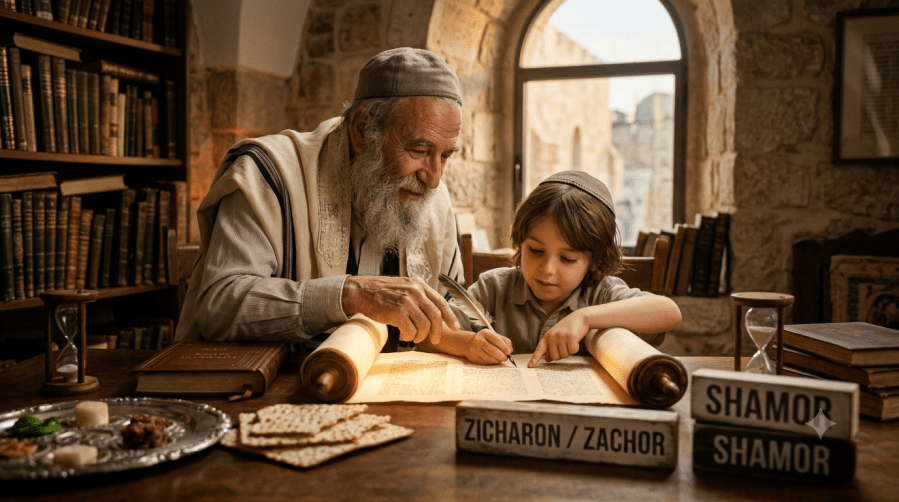
This wasn’t about building an academic elite. It was a survival strategy built on mass literacy. But formal schooling was only half the equation. The real secret weapon wasn’t just classroom study – it was experiential storytelling.
Take Passover. The Seder isn’t a lecture or a dry history reading. It’s an interactive, psychological masterclass. It’s structured around four different types of children, acknowledging centuries before modern education theory that kids learn differently and need tailored entry points. The Haggadah doesn’t say, “Learn about what happened to your ancestors.” It demands: “In every generation, a person is obligated to see themselves as if they personally left Egypt.” You eat the bitter herbs, taste the matzah, and lean at the table. You don’t just study history; you step onto the stage and relive it.
Rebbe Nachman of Breslov leaned heavily into this concept. When standard intellectual discourse felt cold or distant, he turned to storytelling – parables and allegorical tales – to wake people up. He taught that true education shouldn’t be a pressure-cooker of fear or heavy-handed force, but rooted in gentle joy (simcha) and simplicity. For Rebbe Nachman, maintaining tradition wasn’t about preserving a dusty museum exhibit. It was about hitchaddashut – constant renewal. Taking the ancient memory (Zicharon) and approaching it every single day as if it were brand new.
That’s the ultimate takeaway from this week’s parsha. Zicharon isn’t a passive archive stored in the back of your brain. It’s an active posture. When you combine daily, community-wide literacy with intergenerational, experiential storytelling, you create an unbroken chain of succession. You aren’t just handing down abstract facts to the next generation – you’re handing down a living memory, a shared identity, and a reason to keep telling the story.

